


Matched pair of Cortiça microphones with Furry Windfilters
299,00 €
incl. 19% VAT plus Shipping Costs
Two omnidirectional condenser microphones in Portuguese cork, matched by hand within 0.5 dB at 1 kHz, with Furry Windfilters for recording outdoors.
Needs 48 V phantom power (P48). Cortiça does not run on plug-in power: check your recorder before ordering.
In the box
- 2 Cortiça microphones, matched
- 2 microphone mounts
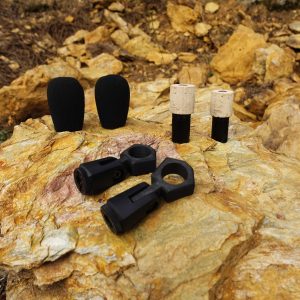
- 2 Furry Windfilters
- Printed manual
In stock (can be backordered)
Listen
Recorded with a matched pair into a TASCAM DR-40X. Not processed.
Why I made it
I built the Cortiça because I needed a set of microphones to record inside beehives. None of the microphones I owned would fit; they were too bulky or too directional. My first prototypes, in 3D printed ABS and metal, produced too much handling noise for recording in the hand, so I tried cork, and the handling noise disappeared. Testing them in different situations, I realised I had made good all-round microphones: for field recording, but also for concerts in an AB pair and for acoustic instruments.
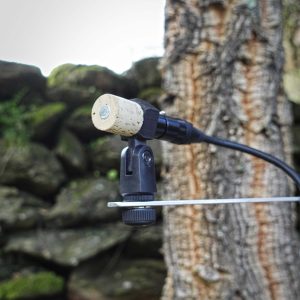
I chose an omnidirectional capsule because it hears a place the way you stand in it, without favouring any direction. The body is made in my workshop from Portuguese cork, which is light, warm in a cold hand, and good at damping vibration.
Good for: ambiences and nature, spaced AB stereo, acoustic instruments up close, and quiet sources where self-noise matters.
Which pair?
| With Foam Windfilters | With Furry Windfilters | |
|---|---|---|
| Best for | Instruments, rooms, sheltered field work | Outdoor field recording |
| Wind | Light breeze | About 25 dB less wind noise at 39 to 49 km/h |
| Matching | Within 0.5 dB at 1 kHz | Within 0.5 dB at 1 kHz |
Specifications
| Type | Omnidirectional condenser |
|---|---|
| Powering | 48 V phantom power (P48) |
| Sensitivity | −24 dB at 1 kHz, ±3 dB (1 kHz @ 50cm) 0 dB=1V/Pa |
| Self-noise | 14 dB-A |
| Signal-to-noise ratio | 80 dB-A (1 kHz, 94 dB SPL) |
| Maximum SPL | 110 dB (THD below 3%) |
| Frequency range | 20 Hz to 20 kHz |
| Output | XLR, balanced, floating |
| Body | Class A natural Portuguese cork and nickel alloy; silver-plated XLR pins |
| Dimensions | Cork body Ø 24 mm, metal body Ø 20 mm, length 57 mm |
| Weight | 30 g per microphone |
Measured
I measure every microphone before it leaves the workshop and use those measurements to pair microphones from the same batch. The response rises by about 8 dB between 3 and 9 kHz: a presence lift that brings out detail in cymbals, strings, voices and birdsong.

Setup
- Press the microphone gently into the mount, all the way up to the cork.
- Only then connect the XLR cable.
- Meeting resistance? Turn the mount 180 degrees.
- To remove: cable off first, then push the microphone out from the back while holding the mount.
Cortiça fits any mount for 19 to 20 mm bodies. It works with any recorder or interface with 48 V phantom power, such as the TASCAM DR-40X used for the recordings above. It works with all ZOOM, Tascam, Sony and Sound Devices recorders that have XLR inputs and phantom power.
Download the Cortiça manual (PDF) · Stereo recording with omni microphones
Questions
How far apart should two microphones be?
Start close, around 25 cm, for intimate sources, and widen to 1 or 2 metres for forests, beaches and halls. Listen while you widen: a thin sound or missing low end means the spacing needs adjusting.
Which stereo bar do you use?
On the road I use the compact K&M 23550; for wider stereo, the K&M 23560. A stereo bar and pistol grip of my own are coming in 2027.
Can I order a custom set?
Yes. Write to me before ordering and tell me what you need; I will tell you what is possible and how long it takes.
What if something breaks?
Every microphone has a two-year warranty on materials and workmanship. Write to me with your order number and I will repair or replace it.
The tripod, recorder and stereo bar in the photos are not included.
Related products
-
Cortiça microphone with mount
109,00 €incl. 19% VAT
plus Shipping Costs
Add to cart -
Matched pair of Cortiça microphones with Foam Windfilters
250,00 €incl. 19% VAT
plus Shipping Costs
Add to cart